
Quality processing services
We provide diverse processing technologies covering metal and plastic components, specializing in the high-precision manufacturing of critical parts for industries such as automotive, marine equipment, industrial machinery, transportation, electronics, and sports. Our services include Aluminum Die Casting, Stamping, Forging, Plastic Injection Molding, and Precision Gear Machining. From mold development and sample prototyping to mass production and delivery, we offer customized solutions based on client needs.
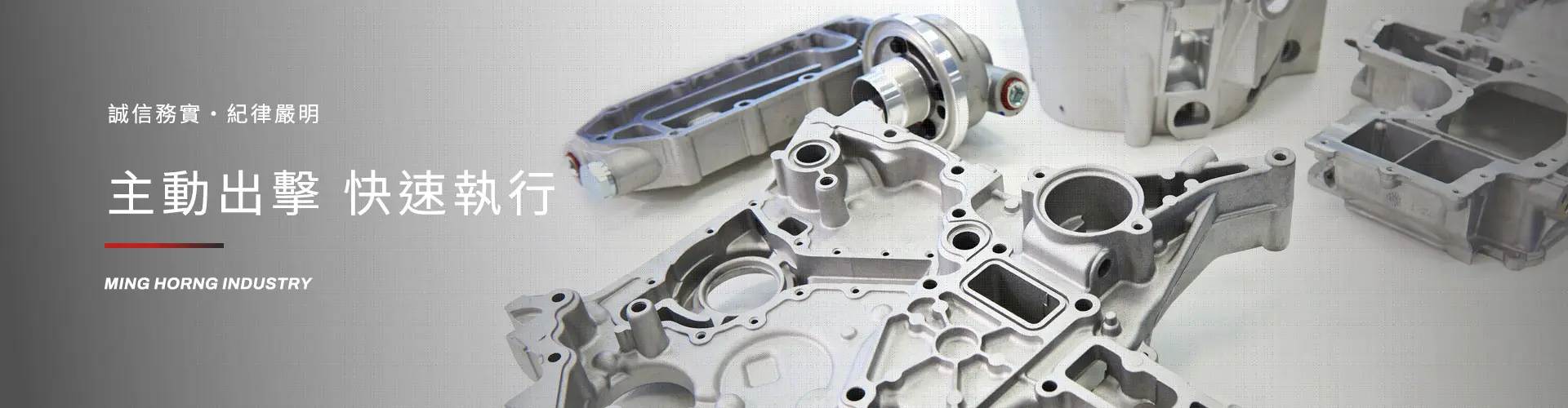
Aluminum die casting is a highly efficient and high-precision metal forming technology, widely used in industries pursuing lightweighting and structural integration. This process involves injecting molten aluminum into a metal mold under high pressure, which then cools and solidifies rapidly, enabling the production of components with complex geometries and high dimensional stability. The resulting parts have high density, stable mechanical properties, and excellent surface quality, making it the best choice for mass-producing thin-walled metal components.
Features of the Aluminum Die Casting Process
- High-Speed, High-Pressure Forming: Uses professional die casting machines to rapidly inject molten aluminum at extremely high pressures (up to 1000-2000 bar) into the mold, effectively filling intricate details and shortening cycle times, thus significantly boosting production efficiency.
- Complex Structures in a Single Shot: Can produce parts with complex geometries such as thin walls, deep cavities, ribs, and internal threads, reducing the number of assembly parts and post-machining steps, which aids in component integration and lightweight design.
- High Dimensional Stability: Products have precise tolerances and excellent consistency, suitable for high-precision assembly requirements. Common precision can reach ±0.05mm, and can be further improved to ±0.01mm with CNC machining.
- Good Surface Quality: The cast parts have a smooth surface with excellent appearance and suitability for post-processing, such as spray painting, electroplating, or anodizing.
- High Material Utilization: Die casting forms parts to near-net shape, requiring little to no machining. Excess material and runners can be recycled, making it cost-effective and environmentally friendly.
- Rapid Mass Production: Long mold life and fast cycle times make it suitable for high-volume production demands, serving as a key processing method for major supply chains like automotive/motorcycle parts, electronic components, and electric vehicles.
Aluminum Die Casting Materials and Applications
We utilize various international standard aluminum die-casting alloys (ADC series) and can provide the most suitable material recommendations based on different functional and industrial needs, as well as product applications, structural characteristics, and post-processing requirements. Commonly used aluminum die casting materials are as follows:
| Material Code | Characteristics | Main Composition | Application Examples |
|---|---|---|---|
| ADC1 | Good castability, average corrosion resistance | Al-Si-Cu | Small machine parts |
| ADC3 | Better corrosion resistance, suitable for anodizing | Al-Si-Cu-Mg | Electronic housings |
| ADC5 | Good corrosion resistance, strong ductility | Al-Mg | Automotive parts |
| ADC6 | High ductility, good machinability | Al-Mg-Si | Precision parts |
| ADC10 | Good castability, medium heat resistance | Al-Si-Cu | Engine housings |
| ADC12 | Most common, good castability & mechanical properties | Al-Si-Cu-Ni | Automotive, appliance parts |
| ADC14 | Good heat resistance, better strength | Al-Si-Cu-Ni-Mg | High-temp mechanical parts |
Service Scope (Wide Range of Applications)
- Automotive & Motorcycle: Transmission housings, engine mounts, light-fixture structural parts, etc.
- Marine Industry: Outboard motor parts, drive shafts, impellers, etc.
- Electronic Products: Heat sinks, controller housings, connector bases, etc.
- Consumer Products: Appliance structures, mechanical handles, support frames, etc.
- Special Purpose: High-temperature zone parts, lightweight structural components, precision modular parts, etc.
Metal stamping is a process that uses dies and high-speed presses to cut, bend, draw, and form sheet metal. This process is especially suitable for high-volume, repetitive production of metal parts, offering advantages such as short production cycles, cost-effectiveness, and high dimensional consistency. Through die design, complex contours and functional structures can be formed rapidly, widely used in marine, automotive parts, home appliance accessories, and precision electronic structures.
Processing Capabilities and Materials
- Supports single-stage dies and progressive dies development
- High-speed presses can achieve daily outputs in the tens of thousands
- Sheet thickness range: 0.2mm - 6mm
- Materials: Stainless Steel (SUS304/316), Cold-Rolled Steel, Galvanized Steel, Aluminum, Copper, etc.
Application Examples
EV mounting brackets, battery box covers, automotive clips and spring contacts, electronic equipment internal metal frames
Forging is a manufacturing process involving the shaping of metal using localized compressive forces, either heated or at room temperature. It significantly improves the metal's internal grain structure density and mechanical strength. Forged parts, known for their high fatigue life and impact resistance, are ideal for applications bearing heavy loads or high-speed operation. Depending on material properties and product requirements, we utilize hot, warm, or cold forging processes to produce various critical components like shafts, gear blanks, connecting rods, and tool handles.
Features of Forged Parts
The forging process aligns the metal's grain flow with the part's contour, strengthening critical stress areas.
Suitable for applications enduring long-term stress or dynamic loads.
Precision dies control shape and dimensions, improving production efficiency.
Ideal for industrial applications with high reliability requirements.
Forging Technology Applications
Applications: Drive shafts, suspension links, differential gears, gear blanks, wrenches, agricultural machinery parts, etc.
Plastic injection molding is a high-efficiency forming technique that involves injecting heated, molten plastic raw material into a precision mold, where it cools and solidifies into the desired shape. This method allows for high-precision, mass production of plastic parts with both structural and aesthetic requirements. In addition to traditional injection, we also offer Hollow Molding (Blow Molding) services, specializing in the production of hollow containers and tubular parts, further expanding the application scope. The entire process supports various engineering plastics and custom mold designs, widely used in industries like automotive interiors, electronic housings, medical devices, and communication devices.
Technical Scope
- Precision Injection (General & Engineering Plastics)
- Two-Shot (Dual-Color) Injection Molding (co-molding or different materials)
- Hollow Molding (Blow Molding): Suitable for bottles, tubes, fuel tanks, etc.
- Injection Compression Molding: Ideal for optical and thin-walled parts
Supported Materials
ABS, PC, PA66+GF, POM, PP, TPE, HDPE, PET-G
Application Examples
Motorcycle light covers, automotive interior trim, mobility scooter control boxes, motorcycle fuel tanks, electronic housings, and torque components
Gears are critical core components in all types of power and transmission systems. Their machining accuracy directly impacts equipment efficiency, noise control, and service life. We have complete processing and inspection capabilities, from gear cutting, hobbing, shaving, and grinding to CMM inspection. We can produce various gear types such as spur, helical, bevel, and worm gears, supporting requirements from small modules to high-precision grades. Whether used in marine parts, automotive transmissions, bicycle gear systems, or robotic arm reduction mechanisms, we deliver stable and consistent quality performance.
Processing Scope
- Gear Types: Spur gears, helical gears, bevel gears, worms, internal gears, racks, etc.
- Processing Tech: CNC Hobbing, Shaving, Form Grinding, Gear ID Grinding
- Module Range: 0.3-10mm, max diameter up to Ø500mm
- Precision Grade: Up to JIS Class 0, DIN Class 6, AGMA Class 10 or higher
- Application Examples: Gear motor core parts, bicycle internal gear hubs, high-speed transmission systems, heavy motorcycle transmission gears, robotic arm precision reduction modules
We offer one-stop metal fabrication services, covering the entire process from material selection, product design consultation, mold development, sample prototyping, and mass production to post-processing and surface treatment.
Our professional engineering team can assist you in integrating mass production considerations early in the product development phase, accelerating the development timeline, reducing development costs, and achieving an efficient transformation from concept to product.
To learn more about our processing capabilities or customized cooperation plans, please feel free to contact us.
Our professional team will provide the most appropriate process recommendations and technical support based on your product needs.
